
Quick Answer
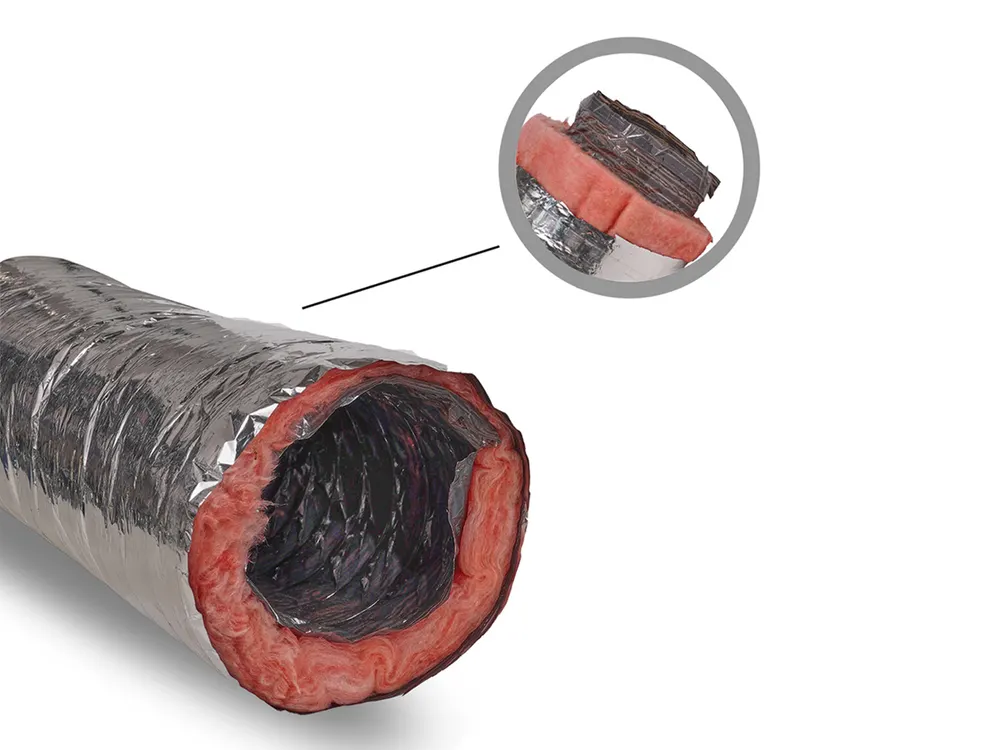
For aircon flexible duct in hot climates, installers order insulated flexible duct — an aluminum foil core, glass wool or polyester wool insulation, and a metalized polyester vapor-barrier jacket. In humid tropical ceilings the job of the insulation is to stop condensation, so thickness and an unbroken jacket matter more than anything else. In Gulf roof spaces the job is to limit heat gain, so 40mm (R6 class) or thicker is the usual pick for long runs. For Australia, specify the metric R-value the project requires and ask for the test basis. Non-insulated duct belongs only inside conditioned space.
Hstube has made flexible duct in Dongyang, Zhejiang since 1996, on 10 production lines with an annual output of about 26 million meters. Our export customers include contractors and distributors in Iraq, Kuwait, Saudi Arabia, the UAE, Australia and Southeast Asia — markets where the duct spends its life in heat and humidity that a temperate-climate spec was never written for. This guide covers what to specify when you order aircon ducting for those conditions. It does not cover airflow sizing; pick diameters with your HVAC designer first.
What Goes Wrong with Aircon Ducting in Hot Climates?
Almost every warranty complaint on flexible aircon ducting in hot markets comes back to one of four problems:
- Sweating jackets and ceiling stains. Cold supply air inside, warm humid air outside. If the jacket surface drops below the dew point of the surrounding air, water condenses on it and drips onto the ceiling.
- Heat gain in roof spaces. Duct running through an unventilated roof void picks up heat along its whole length, so the air leaving the outlet is warmer than the air leaving the unit and the system struggles to hold the room temperature.
- Compressed insulation. Tight hanger straps, kinks and ducts pulled over sharp edges squash the insulation, and a squashed section has a fraction of its rated value. Condensation usually starts at those points.
- Broken vapor barrier. A torn jacket or an untaped joint lets humid air reach the cold core. The insulation gets wet and stops insulating.
None of these is solved by the aircon unit. They are decided when you choose the duct and when it is installed.
Which Insulated Ducting Fits Which Climate?
These picks are grouped by installation situation, in no ranking order. Diameters are 4"–20" (100–500mm) for all insulated lines except the soundproof duct, which stops at 16" (400mm).
| Market / situation | Main risk | Usual choice | Why |
|---|---|---|---|
| Gulf (UAE, Saudi Arabia, Kuwait, Iraq): runs through roof spaces and plant areas | Heat gain | R6 (40mm) or R8 (80mm) insulated flex duct | Thicker insulation for long runs in very hot spaces; check the outer diameter fits the void |
| Southeast Asia: ceiling voids in humid buildings | Condensation | R6 (40mm) insulated flex duct; R4.2 (25mm) for short drops inside partly conditioned space | Keeps the jacket surface above dew point; the jacket must be continuous |
| Australia: ducted air con in roof spaces | Heat gain + code R-value | Insulated flex duct to the metric R-value the project requires | NCC minimums depend on climate zone; ask for the test basis (see below) |
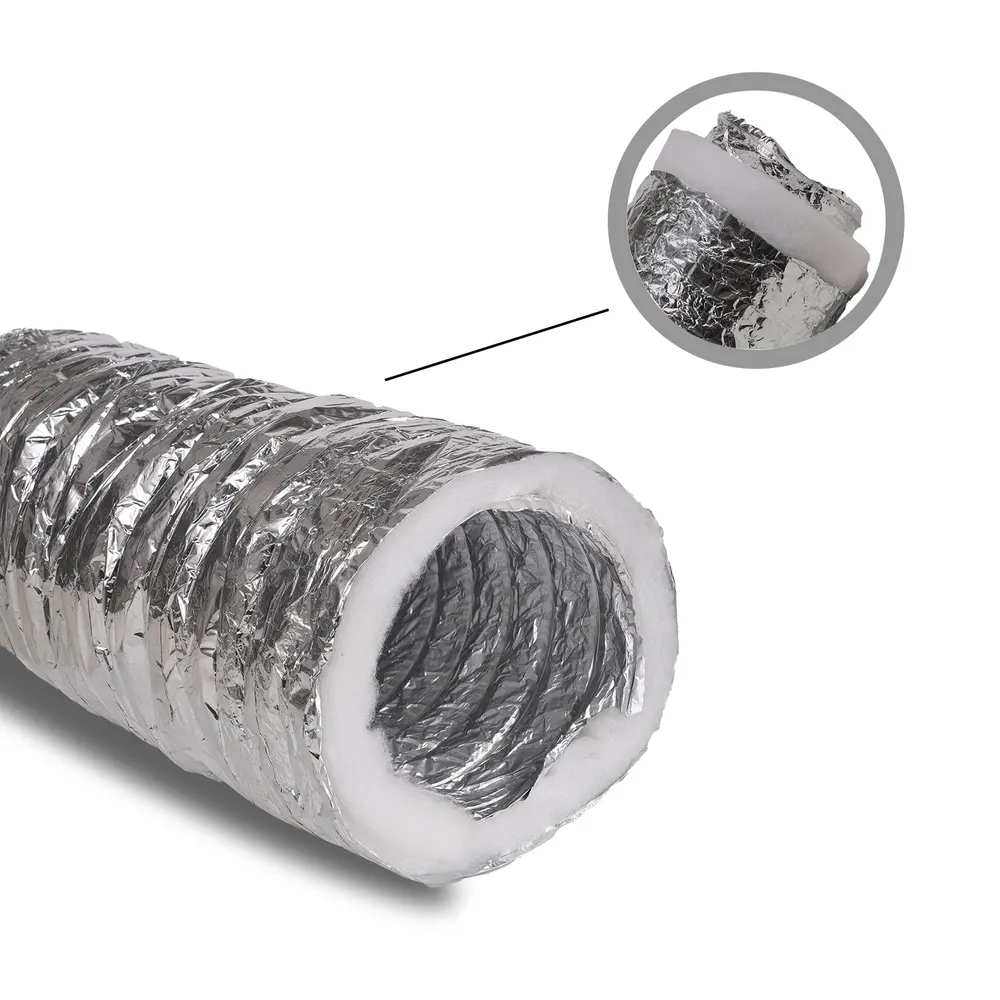
| Projects where installers or occupants avoid glass fiber | Handling and comfort | Polyester insulated flex duct (100–250 g/m²) | Fiberglass-free, non-irritant insulation with the same foil core and vapor-barrier jacket |
| Hotels, offices, bedrooms | Noise + condensation | Soundproof insulated duct (up to 16") | Acoustic inner liner plus 25mm insulation and vapor barrier |
| Inside conditioned space only | — | Non-insulated aluminum or polyester flex duct | No temperature difference to manage; lighter and cheaper to ship |
How Much Insulation Stops Condensation?
Condensation is a surface-temperature problem. The duct carries cold supply air; the insulation keeps the outer jacket close to the temperature of the surrounding air. The thicker the insulation, the warmer the jacket stays — and the wider the gap between the jacket temperature and the dew point of the air around it.
That is why humid markets are harder than hot, dry ones. In a ceiling void in a tropical city, the dew point of the trapped air is often only a few degrees below the air temperature, so a duct that never sweats in a dry climate can drip in Southeast Asia. The practical rules:
- Size insulation for the worst space the duct passes through, not the average. One unconditioned roof section can sweat while the rest of the run is fine.
- Our insulated lines in order of thickness: 25mm (R4.2 fiberglass, polyester wool), 40mm (R6), 80mm (R8). Glass wool is 16 kg/m³; polyester wool comes in 100, 150, 200 or 250 g/m².
- Thickness costs space and freight. At 16" an R8 duct is roughly 22" (560mm) outside before compression; our large-diameter flex duct guide has the outer diameters for 14"–20". If R6 meets the requirement, it is often the better choice for tight ceilings and for container loading.
Not sure which thickness the job needs? Send us the climate, the space the duct runs through and the diameters, and we will suggest a construction to quote.
Imperial vs Metric R-Values: How to Read a Spec from Another Market
Export orders often mix rating systems. A US-style product label shows imperial R-values (ft²·°F·h/BTU); Australia, much of Asia and the Middle East specify metric R-values (m²·K/W). To convert imperial to metric, divide by 5.678:
| Hstube line | Insulation | Nominal imperial rating | Metric equivalent (approx.) |
|---|---|---|---|
| Fiberglass insulated flex duct | 25mm glass wool, 16 kg/m³ | R4.2 | ~R0.74 |
| R6 insulated flex duct | 40mm glass wool, 16 kg/m³ | R6 | ~R1.06 |
| R8 insulated flex duct | 80mm glass wool, 16 kg/m³ | R8 | ~R1.41 |
Arithmetic conversion of nominal ratings, not a test result. A tested metric R-value depends on the test method and on the exact construction; ask for the documented value of the item you are ordering.
The most common mistake is reading “R6” on an imperial label as if it were metric R6 — a factor of almost six. When a drawing or tender just says “R1.0” or “R6”, confirm which system it means before you order.
Jacket, Core and Installation Details for Hot Markets
The insulation only works if the layers around it stay intact. Details to specify and to brief installers on:
- Inner core: aluminum foil laminate with a steel wire helix on our insulated lines. The core carries the air and must be sealed to the collar with aluminum foil tape and a clamp.
- Outer jacket: metalized polyester vapor barrier (heavy-duty on R6/R8). Pull it over the insulation at every joint and tape it separately — taping only the core leaves a path for humid air.
- No direct sun. Flexible duct jackets are not made for outdoor exposure. On roofs and terraces, use rigid duct with weatherproof cladding and keep flex duct for the short connections inside.
- Support without crushing. Use wide straps or duct hangers at no more than 5 ft (1.5m) spacing, pull the duct taut and avoid tight bends. Every crushed section is a cold spot.
- Temperature rating: our insulated ducts are rated −20°C to +120°C (−4°F to +248°F), well above roof-space temperatures in Gulf summers.
Which Test Reports Do Hot-Climate Markets Ask For?
Requirements differ by market and by project. What we can document today, with report numbers you can verify with the laboratory:
| Document | What it covers | Report No. |
|---|---|---|
| AS 4254.1-2021 clause 5.3.2 (Australia), AWTA Ltd | Airwise Flex R1.0 insulated flexible duct, 300 mm (PET film + polyester insulation) — the tested product only | 25-001387 (2025-04-28) |
| Fire classification M1, NF P 92-507 (France), SGS | Insulated flexible air duct (aluminium foil + glass wool, ~50 mm), 10" sample | XMHL250700545501SD (2025-08-13) |
| RoHS 2011/65/EU + (EU) 2015/863, GTS | Flexible duct, D76–D600 | GTS2107230431EN (2021-07-28) |
UL 181 listing for our flexible ducts is in progress, not granted. Many Gulf and Southeast Asian projects follow the consultant’s specification rather than a single national standard, so send us the spec clause and we will tell you before you order what we can and cannot document. Full reports are available on request; see all test reports.
MOQ, Lead Time and What to Put in the RFQ
| Item | Terms |
|---|---|
| Standard catalog sizes | Small quantities accepted; mixed diameters and insulation grades on one order |
| Custom sizes, private label, OEM packaging | Typically 500–1,000 pieces, depending on product |
| Standard length | 25 ft (7.6m); custom lengths quoted on request |
| Samples | Typically 7–10 business days |
| Lead time | Catalog items 15–20 business days after payment; custom / OEM 30–45 days |
For a complete quote in one reply, include:
- Diameters and quantities (pieces or meters).
- Insulation: thickness or R-value, and whether the R-value is imperial or metric.
- Where the duct runs: roof space, ceiling void, plant room, conditioned space.
- Glass wool or polyester wool; acoustic lining if needed.
- Required test documents for your market or project specification.
- Length per piece, packaging (neutral or private label) and carton marks.
- Destination port and preferred trade terms.
Browse the full insulated duct range or our FAQ for more order questions.
Get a Quote for Insulated Aircon Ducting
Tell us the market, the space the duct runs through, sizes and insulation. We reply within 24 hours with pricing, lead time and packing details.
Request a quote for your project
Tell us your requirements. We respond within 24 hours on business days.